Google’s Learn About reframes both search and chat as an explore-first learning loop. It lowers the cost of asking good questions, manages cognitive load with structured, clickable cards, and continuously surfaces “questions you didn’t know to ask.” Users resolve a specific doubt while simultaneously zooming out to the surrounding question space, all without breaking their thinking flow.
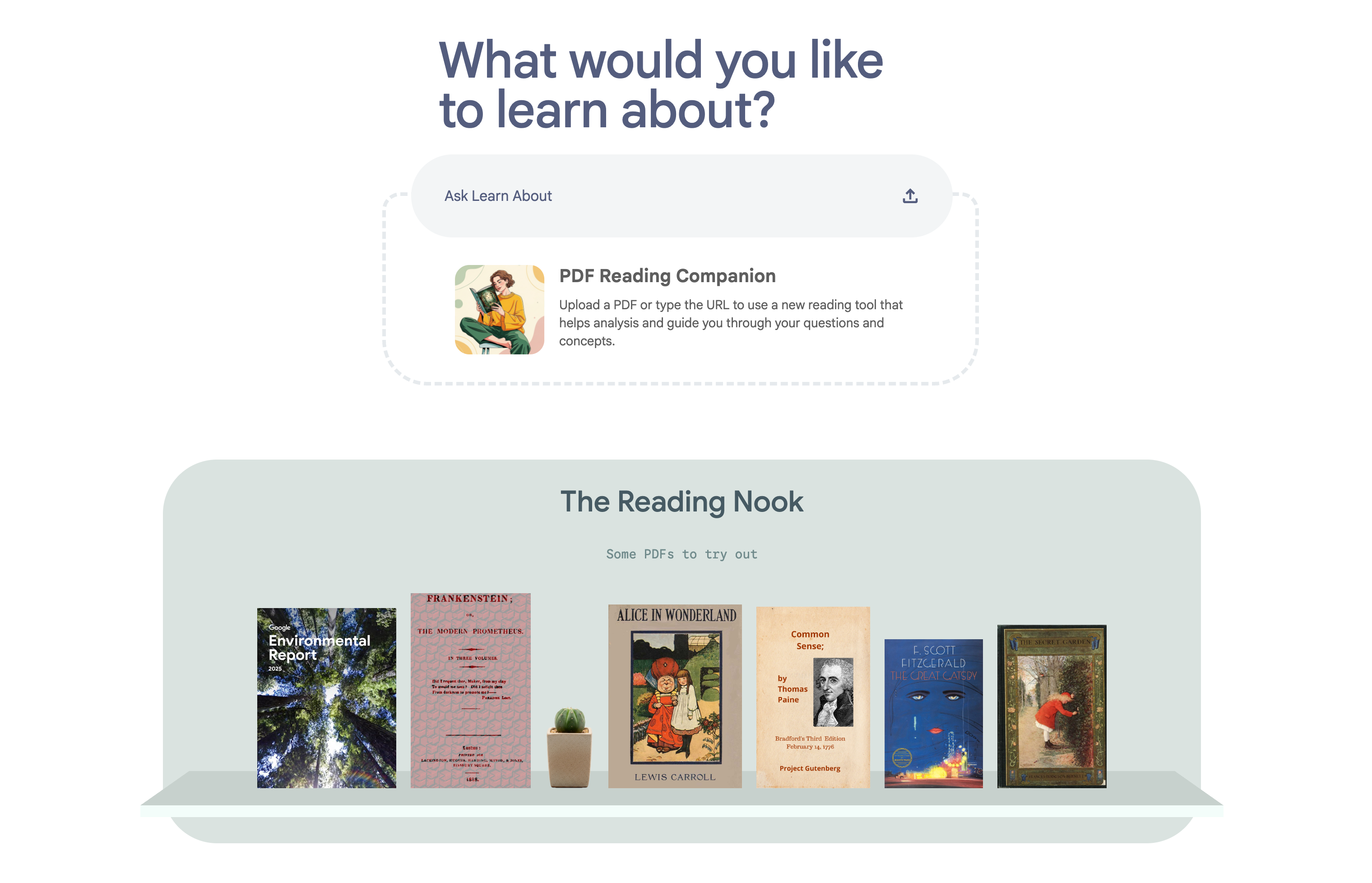 Learn About’s clean interface design centers around the core question “What would you like to learn about?” The PDF Reading Companion offers guided document analysis, while The Reading Nook provides curated book exploration with visual book covers that invite browsing and discovery.
The Problem: Friction in Learning Discovery
Most learners struggle with two recurring frictions: picking what to study and understanding what they picked. Learn About addresses both by turning fragmented minutes into genuine learning and durable curiosity. It does this by minimizing the friction of asking, embedding follow-up modules directly inside answers, and maintaining interactivity so that exploration continues without re-prompting.
The experience privileges clarity, moderate information density, and explicit emphasis on what matters most, which together reduce overload while preserving momentum. Reflection is encouraged through timely prompts and lightweight feedback, and the system adapts to the learner by adjusting difficulty, sequencing, and recommendations as it observes preferences and progress.
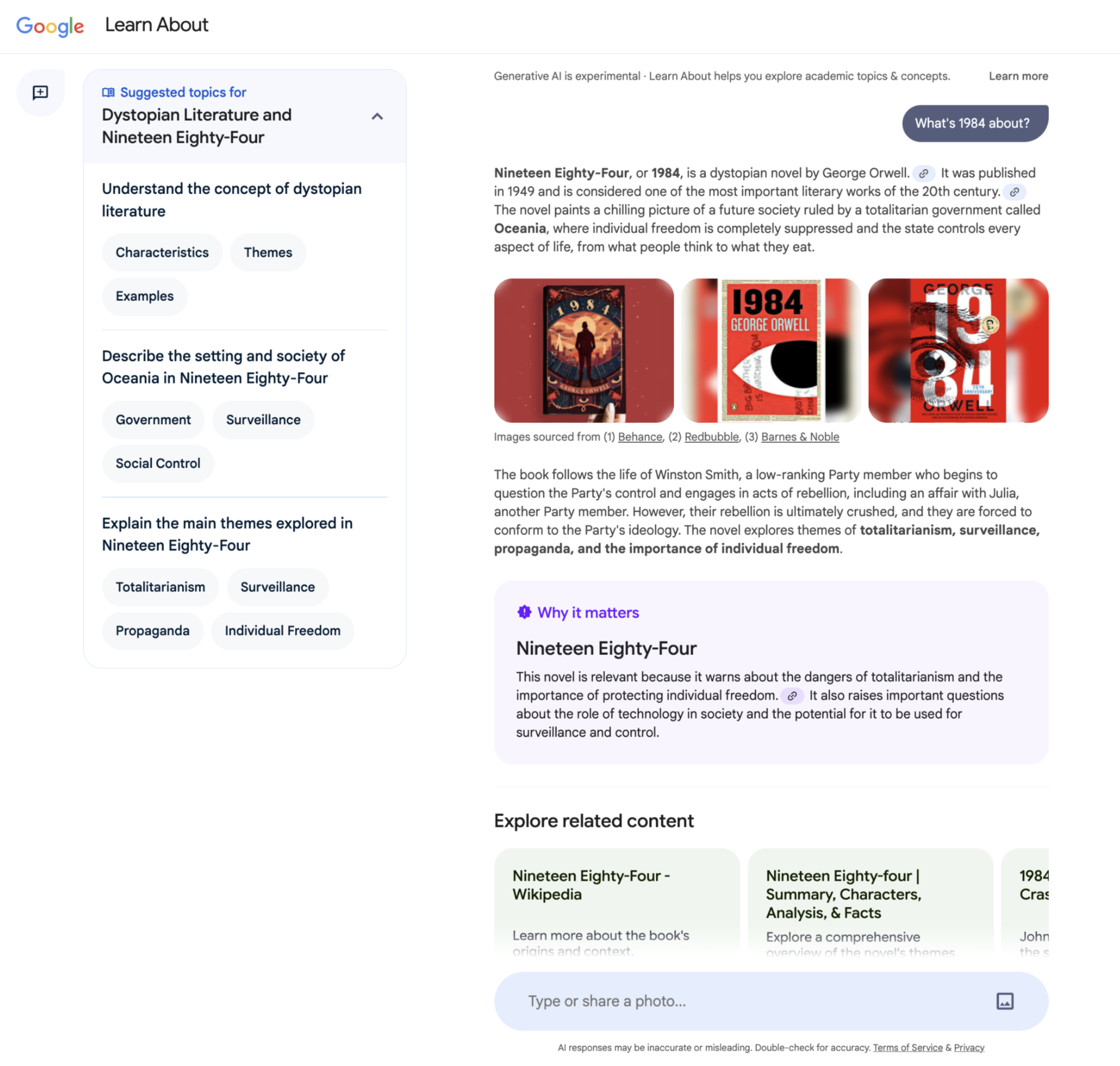 Learn About’s interface for exploring “Dystopian Literature and Nineteen Eighty-Four” demonstrates the card-based approach with suggested topics, contextual information, and interactive elements that maintain learning flow.
What Makes “Learn About” Different
The single biggest unlock is that Learn About lowers the cost of asking. Instead of waiting for users to craft perfect prompts, it embeds ready-to-tap follow-ups into each response so the next question is one click away. Equally important, it lets users zoom out without losing the thread by showing neighboring questions alongside the current answer. This arrangement promotes deeper dives and lateral pivots within the same cognitive flow.
Because it blends search-grade grounding and multi-modal sourcing with the flexibility of conversational chat, users get precise, cite-able synthesis that remains responsive and compact. Most distinctively, Learn About treats “unknown unknowns” as a first-class job to be done by regularly proposing high-leverage sub-questions and adjacent topics that expand the learner’s map.
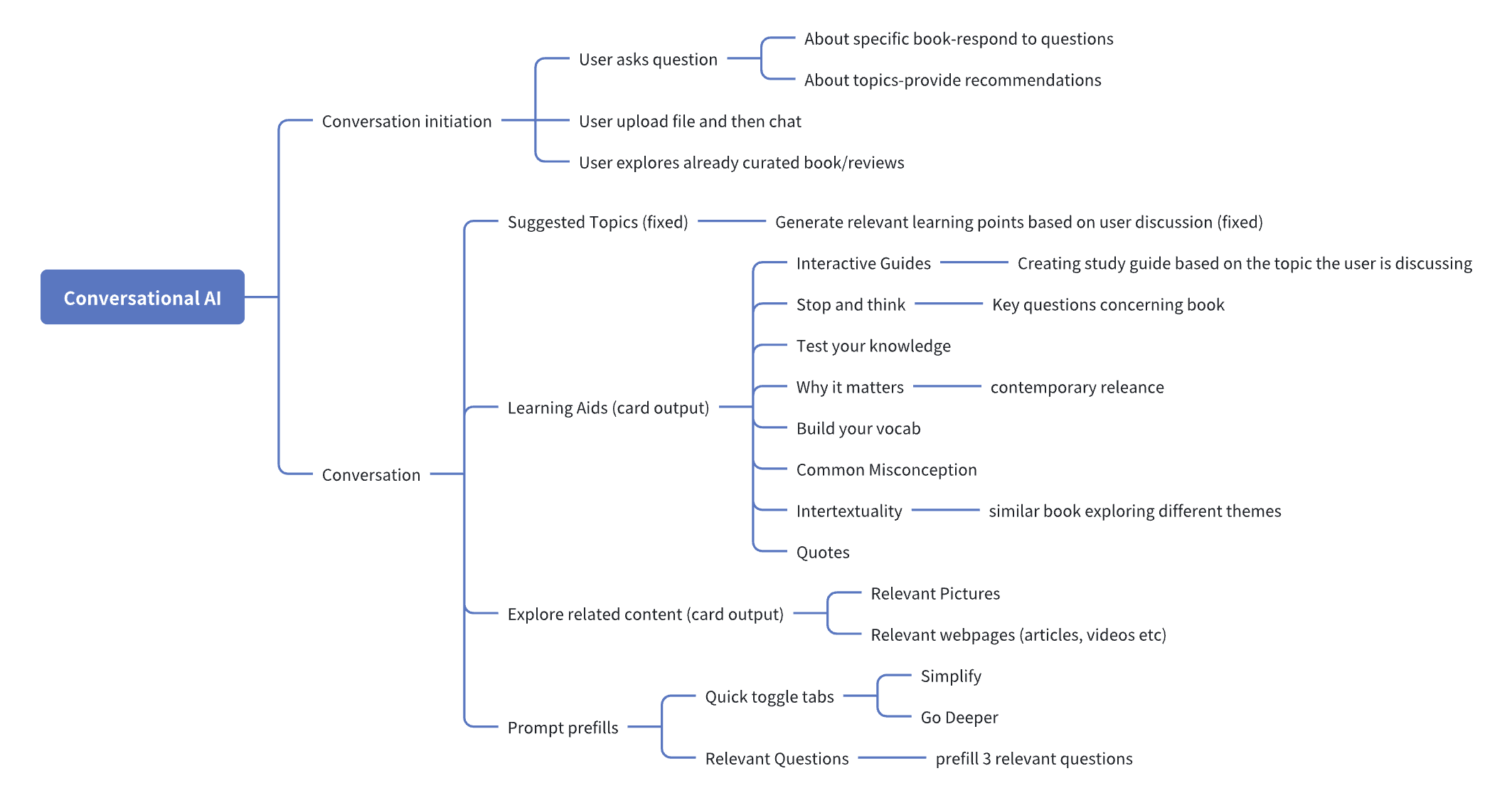 The conversational AI system architecture shows how Learn About structures the learning experience through suggested topics, learning aids, exploration cards, and smart prefills that reduce prompting friction.
Interactive Cards: The Core Design Pattern
Cards are the core unit of meaning and motion in Learn About. The system provides multiple card types that give learners different ways to proceed without retyping:
Interactive Lists present related content in browsable, clickable formats. For example, when exploring “The Scream,” users can browse different versions of the artwork with visual thumbnails and contextual information.
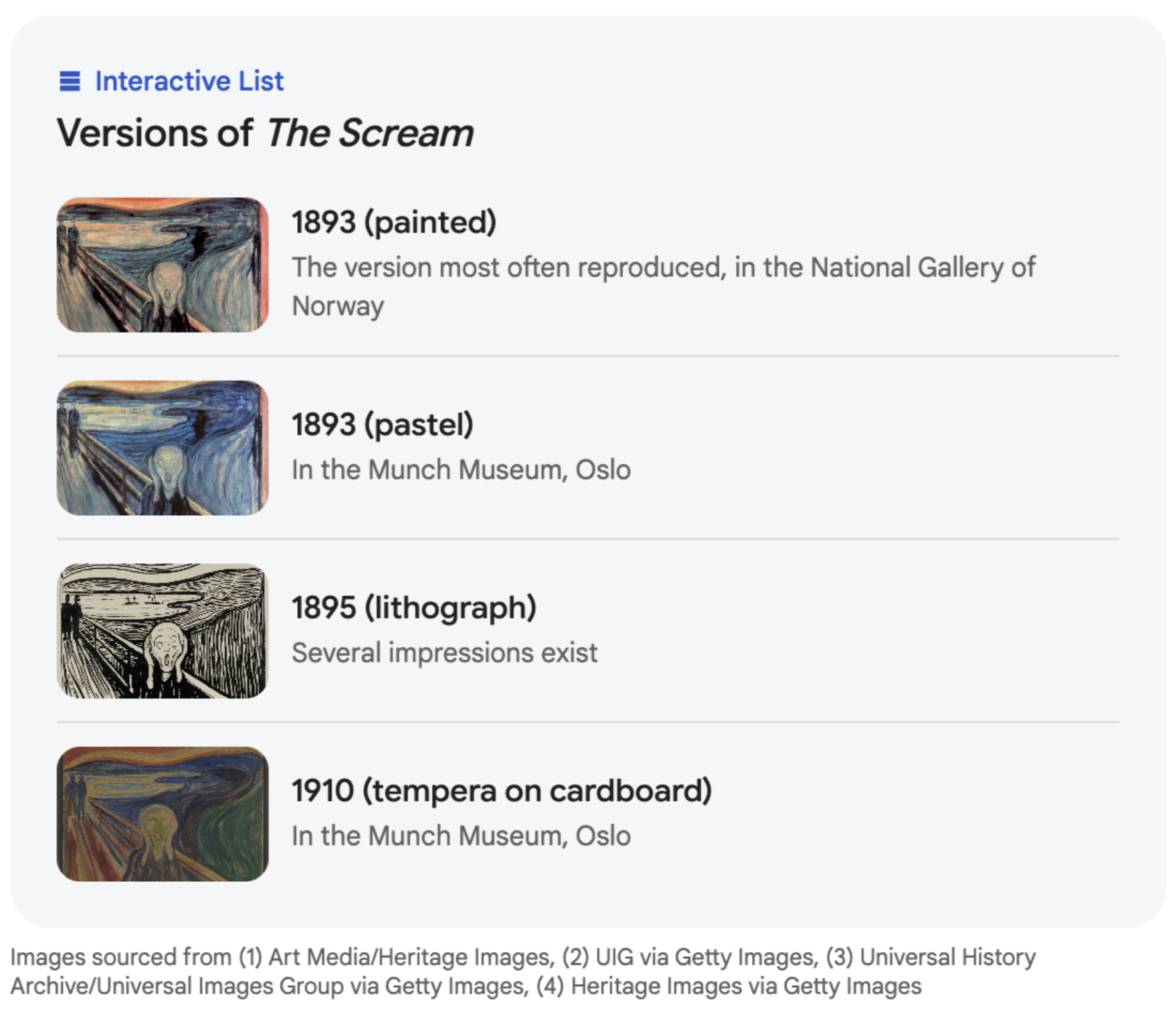 Interactive List cards allow users to explore related content visually, as shown with different versions of “The Scream” painting, each with thumbnail images and descriptive details.
“Why It Matters” Cards explain contemporary relevance and applications. These cards help learners understand why historical or abstract concepts remain significant today.
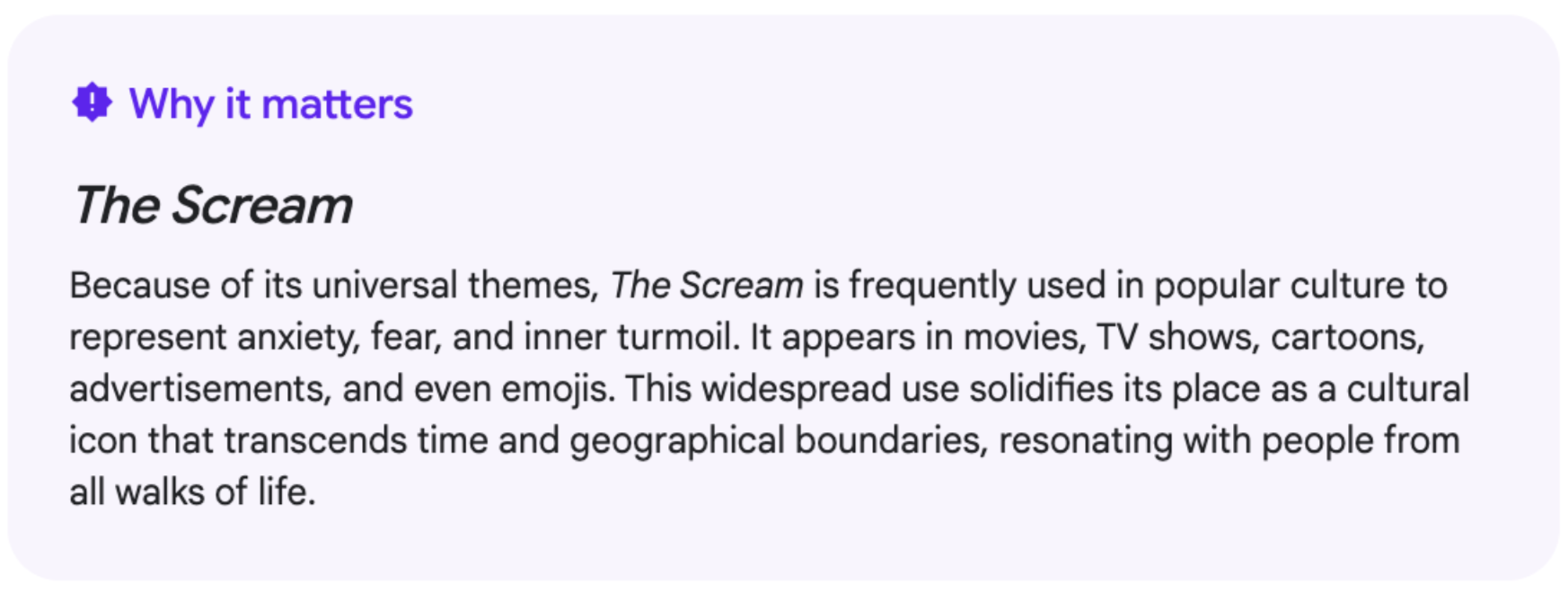 “Why It Matters” cards provide contemporary context, explaining how “The Scream” became a universal cultural icon representing anxiety and inner turmoil across different media.
Knowledge Checks convert passive reading into active recall. These lightweight quizzes help reinforce learning without breaking the exploration flow.
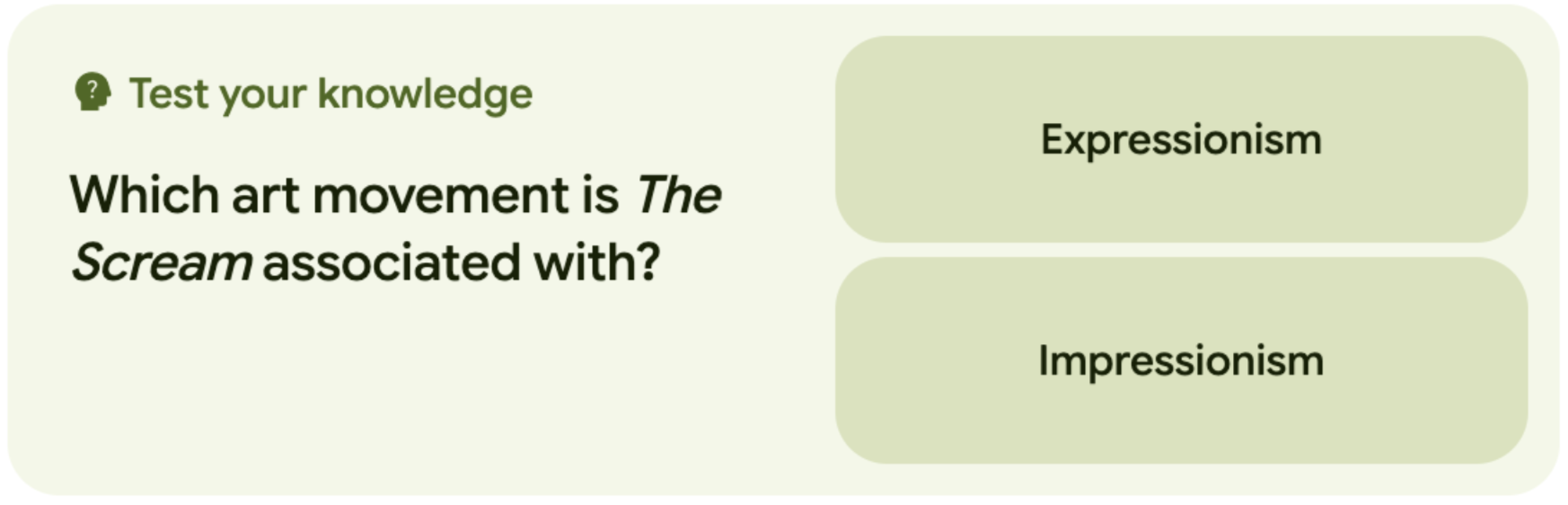 Knowledge check cards engage users with interactive quizzes that test understanding while maintaining the conversational flow.
Vocabulary Builders introduce and define key terms with pronunciation guides and clear explanations.
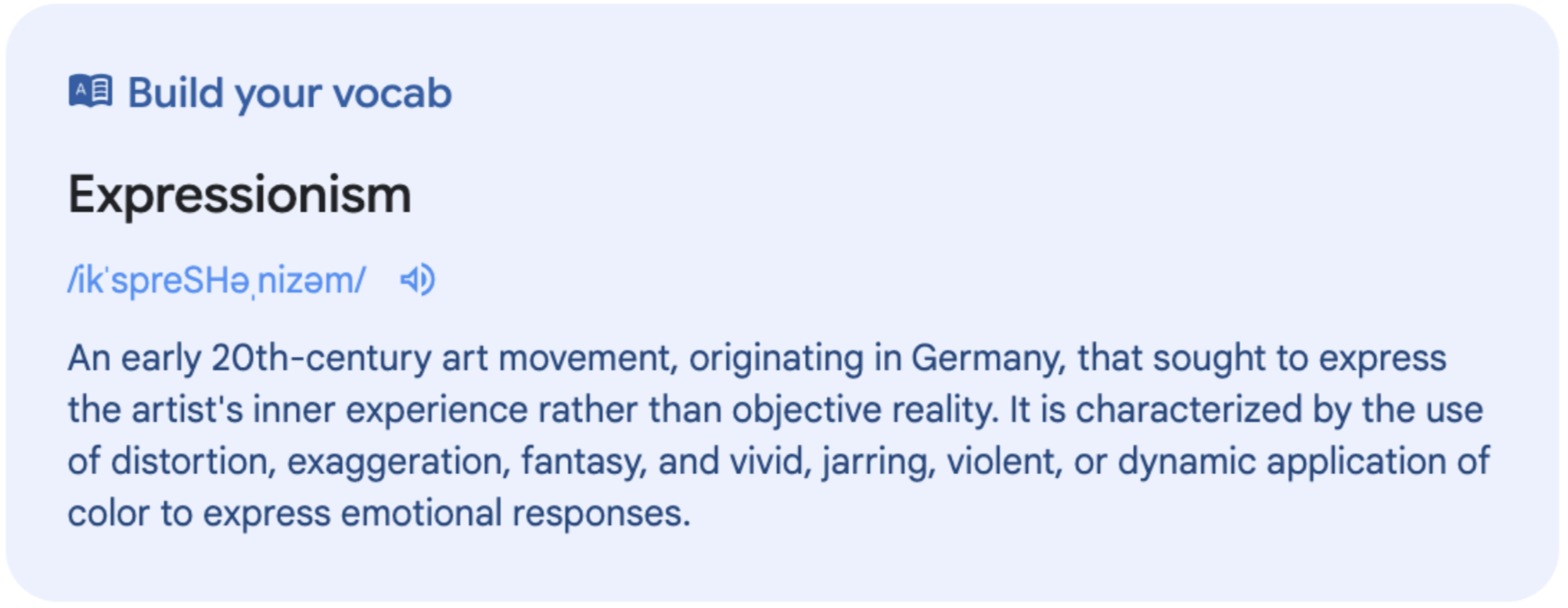 Vocabulary cards provide pronunciation guides and comprehensive definitions, helping learners build domain-specific knowledge progressively.
Simple controls like “Simplify,” “Go Deeper,” and “Get Quotes” let learners tune granularity on demand. Smart prefills provide a few contextually relevant starters so that continuing the thread always feels one tap away.
“Learn About,” Adapted to Books
A reading-first Learn About helps people quickly grasp and then deepen a book’s ideas through short, lively exchanges that unfold as modular replies. The system demonstrates sophisticated contextual awareness by dynamically suggesting related topics and themes as users explore literary works.
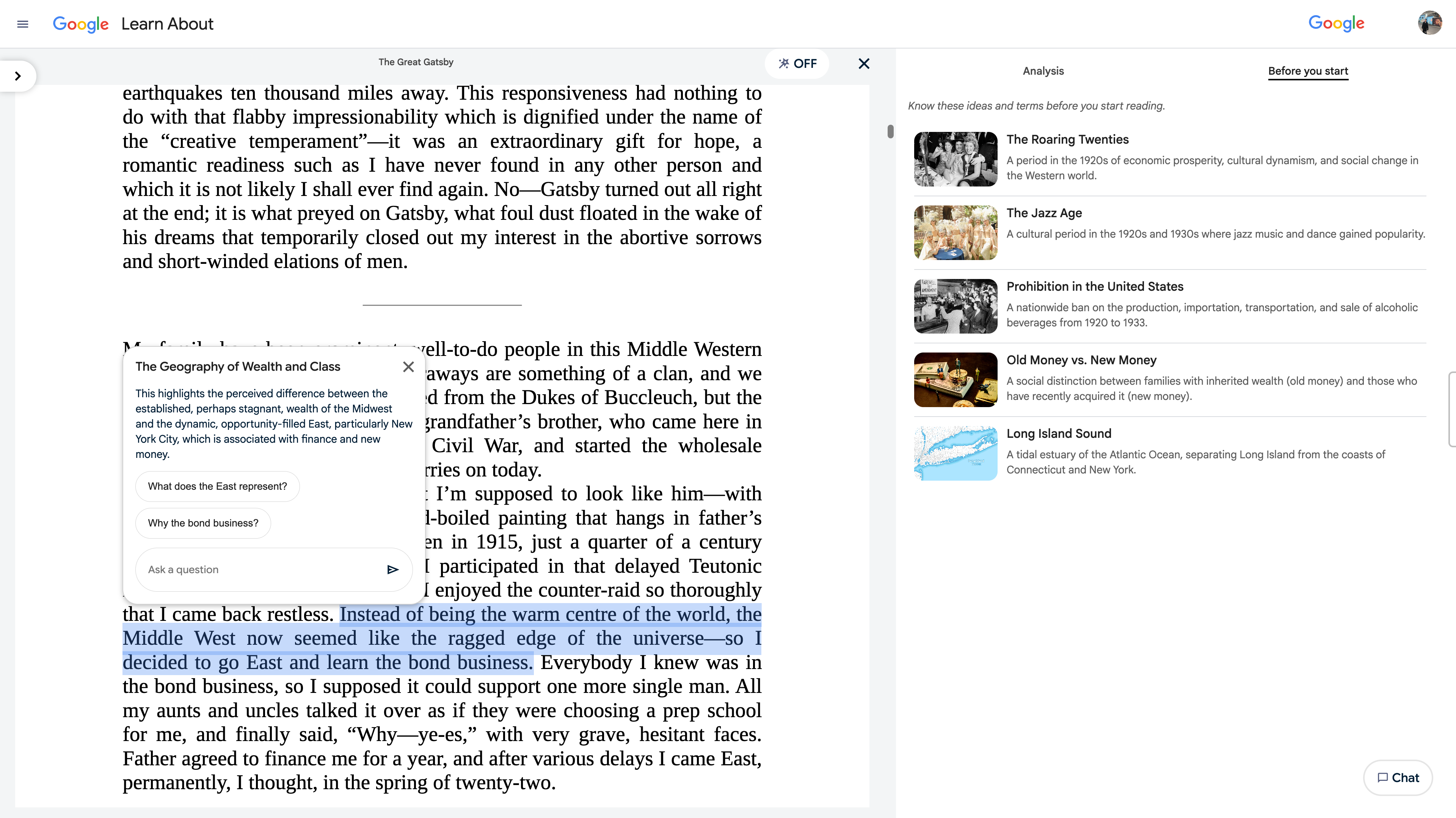 The contextual sidebar shows how Learn About surfaces related historical and cultural topics while reading The Great Gatsby, including “The Roaring Twenties,” “The Jazz Age,” and “Prohibition in the United States,” creating natural pathways for deeper exploration.
Key components include Contextual Background that clarifies the time, author, and intellectual setting, Key Concepts that introduce terms and definitions with crisp explanations, Reflection Prompts that invite a pause to think before proceeding, Relevance Notes that explain why an idea matters now and where it applies, Intertextual Pointers that connect the current book to contrasting viewpoints elsewhere, and Quotations that anchor the discussion in the text with light annotation that preserves the author’s voice.
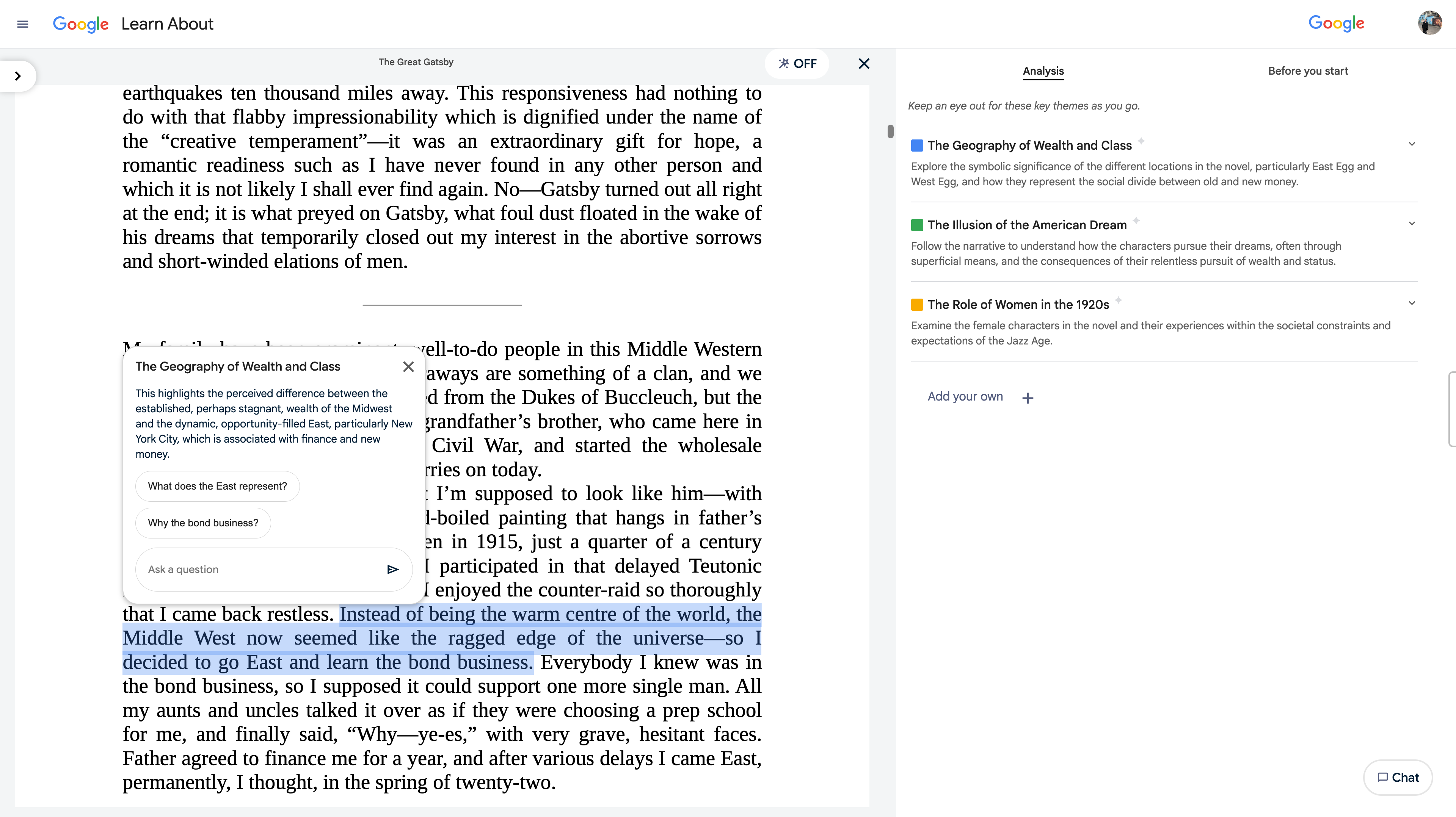 The analysis interface demonstrates Learn About’s depth by providing thematic breakdowns like “The Geography of Wealth and Class,” “The Illusion of the American Dream,” and “The Role of Women in the 1920s” alongside the primary text, enabling rich contextual learning.
Every element is designed to be tappable so that the next micro-question feels like continuing a conversation rather than composing a fresh prompt. This creates a seamless learning experience where curiosity drives discovery rather than predetermined lesson plans.
Competitive Positioning
General-purpose LLMs offer flexible dialogue but depend heavily on the user’s prompting skill and do not consistently deliver structured learning surfaces. Traditional search excels at source grounding but leaves the curation, triage, and synthesis to the user. Community forums provide depth and texture at the cost of time and noise, since value is scattered across threads.
A reading-focused Learn About occupies the middle ground: it retains search-level grounding and community-like richness while orchestrating everything into concise, interactive cards that reduce question friction and guide depth. In practice, this means less skimming, less context-switching, and more time spent understanding.
Core Product Logic
Two design commitments drive the experience:
Reduce Prompting Cost: The interface embeds good questions into the prior answer so the user advances with clicks rather than blank-box composition.
Maximize Effective Information: Each turn delivers the smallest amount needed to unlock a next action, whether that means asking a sharper question, recognizing a pivotal idea, or applying something concrete.
Short, modular replies keep attention intact and make it obvious where to go next.
Implementation Strategy
Scope and Roadmap for Books Domain
Coverage should begin with a well-curated canon of classics that already have rich secondary literature, then expand toward the long tail through retrieval-augmented generation. Structured sources such as high-quality guides and glossaries can provide reliable scaffolds, while unstructured sources such as reviews and community discussions add nuance and counterpoints.
Multiple entry points make the system feel native in different contexts:
- Main conversation for direct book Q&A
- Podcast page for audio-led overview that feeds context into chat
- Search page for natural-language book finding grounded in catalog corpus
- Book detail page for deep dives seeded by highlights or chapters
Personalization and Memory
A lightweight user model grows with every interaction by observing which cards the learner opens, where they came from, and what they bookmark. Over time, the system tunes difficulty, chooses modalities that fit a person’s habits, and proposes recommendations that align with their goals. The aim is not heavy-handed adaptation but gentle alignment that keeps the learning curve inside the user’s zone of proximal development.
Technical Implementation
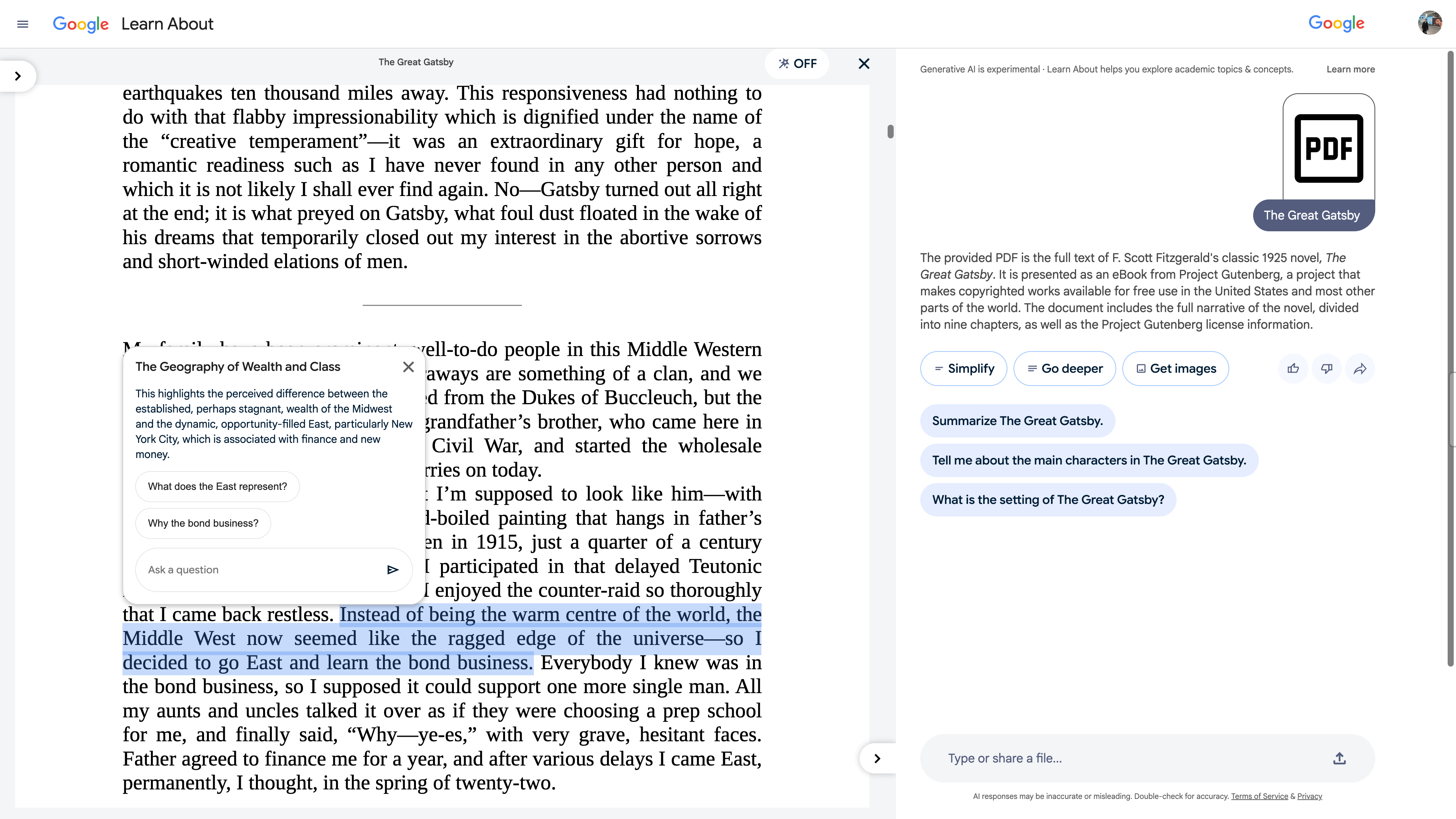 The PDF Reading Companion showcases Learn About’s document analysis capabilities, providing contextual information about “The Great Gatsby” with options to “Simplify,” “Go deeper,” or “Get images,” demonstrating the system’s adaptive response to user learning preferences.
A simple Node.js and Firebase stack is sufficient for a working prototype. An ad-hoc but consistent JSON schema can power card templates, and a clear behavioral system prompt can keep outputs compact, structured, and render-ready. Resource types may include articles, diagrams, videos, photos, timelines, and tables, each with known fields that the renderer expects.
The PDF Reading Companion interface reveals sophisticated document processing capabilities that maintain context across different interaction modes. Users can seamlessly transition between reading the source material and exploring related concepts, with the system maintaining awareness of their current position and learning objectives throughout the session.
Start with a few shot examples and conservative temperature, then graduate to lightweight finetunes for the related-question generator as traffic grows and patterns stabilize.
Great questions live in the long tail, so the system benefits from synthetic query generation to probe coverage gaps and from semantic clustering to compare what people ask with what they ought to ask to progress. Early on, a straightforward retrieval pattern—embeddings, top-k selection, and generation that honors a card schema—establishes reliability.
Measuring Success
Interaction Quality shows up directly in average turns per session and card click-through rates, as well as explicit helpfulness signals such as upvotes and downvotes. Learning Outcomes can be proxied through completed knowledge checks, intertextual clicks that lead to saved or started books, and the frequency with which users choose to go deeper rather than simplify. Personalization should be evaluated by comparing engagement and conversion on individualized suggestions against generic baselines.
Extensions: Listen-In Experiences
Two sidecar experiences can broaden appeal without complicating the main loop:
Reader Panel synthesizes community viewpoints into a short, host-led exchange that captures live debate in a couple of minutes of text or audio. Expert Panel synthesizes book content and academic sources into a focused discussion on a theme. Both can be pre-cached and surfaced as contextual cards that invite a quick listen before jumping back into interactive exploration.
Why This Pattern Wins
Learn About is learner-centric rather than content-centric. It starts from a live confusion and expands the neighborhood around it without demanding more effort than a tap. It preserves attention by keeping answers short, modular, and emphatic about what matters now. It compounds value as every interaction sharpens the system’s sense of what to show next.
Most importantly, it is a portable blueprint: the same mechanics that make it excellent for books also apply to lectures, papers, podcasts, and any domain where exploration precedes mastery. By treating curiosity as a navigable space rather than a series of isolated questions, Learn About transforms how we think about AI-assisted learning—from reactive query-response to proactive knowledge exploration.
The future of learning isn’t about better answers to the questions we already know to ask. It’s about systems that help us discover the questions we never thought to ask, making the unknown knowns visible and actionable. Google’s Learn About shows us what that future looks like: not just smarter search, but curiosity as an interface.