Sam Altman said in a recent post: “We’re gonna see 10-person billion dollar (valuation) companies pretty soon. In my little group chat with my tech CEO friends, there’s this betting pool for the first year that there is a one-person billion-dollar company. Which would have been unimaginable without AI and now will happen.”
As AI coding agents become increasingly capable—moving beyond code generation to CI/CD pipelines and automated testing—an ambitious founder could outsource the work they would traditionally use employees for to an army of artificial intelligence agents. Theoretically, this would allow entrepreneurs to focus exclusively on their most important competitive advantage.
While for many of us it might seem we’re close to this vision, I’m interested in thinking about how this applies more broadly, signaling a fundamental disruption in knowledge work. Looking at engineering and product friends who left big tech to work on their own thing, or are building something part-time, a pattern emerges. Coding and actually shipping the product has become table stakes. With some Cursor brilliance, Supabase magic, and Stripe configurations, you could have a fully functional product within a week.
But the harder part? Realizing that you’ve created the same thing the other 100 indie developers thought of—the usual notetakers, voice journals, travel apps. You came up with something that felt obvious based on your own observations, but it’s not what users actually demand. Or you simply didn’t map out competition beforehand. What also becomes hard and blocks 90% of new vibe builders is distribution. Creating content by hand requires artisanship and patience. After the first 10 videos don’t blow up, you might just call it quits.
These are the pains we’ve felt building CrowdListen, and empathized with during customer interviews. That’s exactly why we’re building CrowdListen—helping Product Managers (defined more broadly) and eventually coding agents decide what to build. We’ve also open-sourced crowdlisten_video to help others exploring in this space leverage the best of OpenClaw.
What follows is the stack we use to run CrowdListen—four AI systems that each handle a distinct function of running a company: knowing what to build, building it, running it, and growing it.
CrowdListen: Knowing What to Build
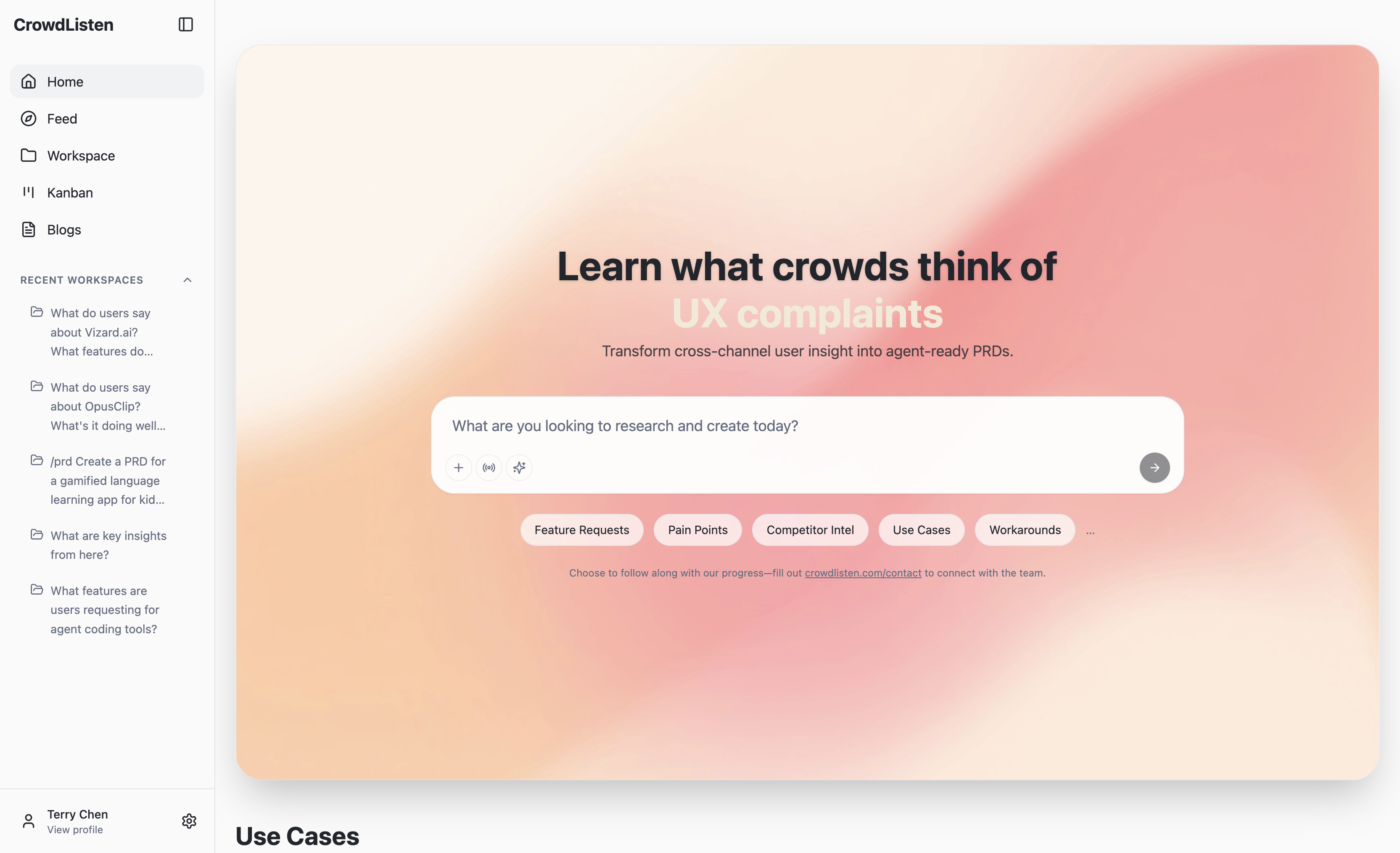 CrowdListen transforms cross-channel user insight into agent-ready PRDs
The hardest part of building products isn’t coding—it’s knowing what to code. Most founders waste months building features nobody wants because they’re operating on intuition instead of evidence. I’ve been guilty of this myself. You convince yourself that because you personally experience a pain point, others must too. Sometimes you’re right. Often you’re not.
CrowdListen is an AI-powered audience insight platform that transforms social conversations into actionable product specs. It aggregates discussions from Reddit, TikTok, Twitter/X, and the broader web, then uses multi-modal AI pipelines to extract themes, cluster feature requests, and rank them by demand signals. The key insight is evidence-backed product decisions. Every insight links to real conversations. You’re not guessing—you’re synthesizing what thousands of people have already told you.
Before building anything significant, I run a deep analysis on the problem space. What are people actually complaining about? What solutions have they tried? What’s missing?
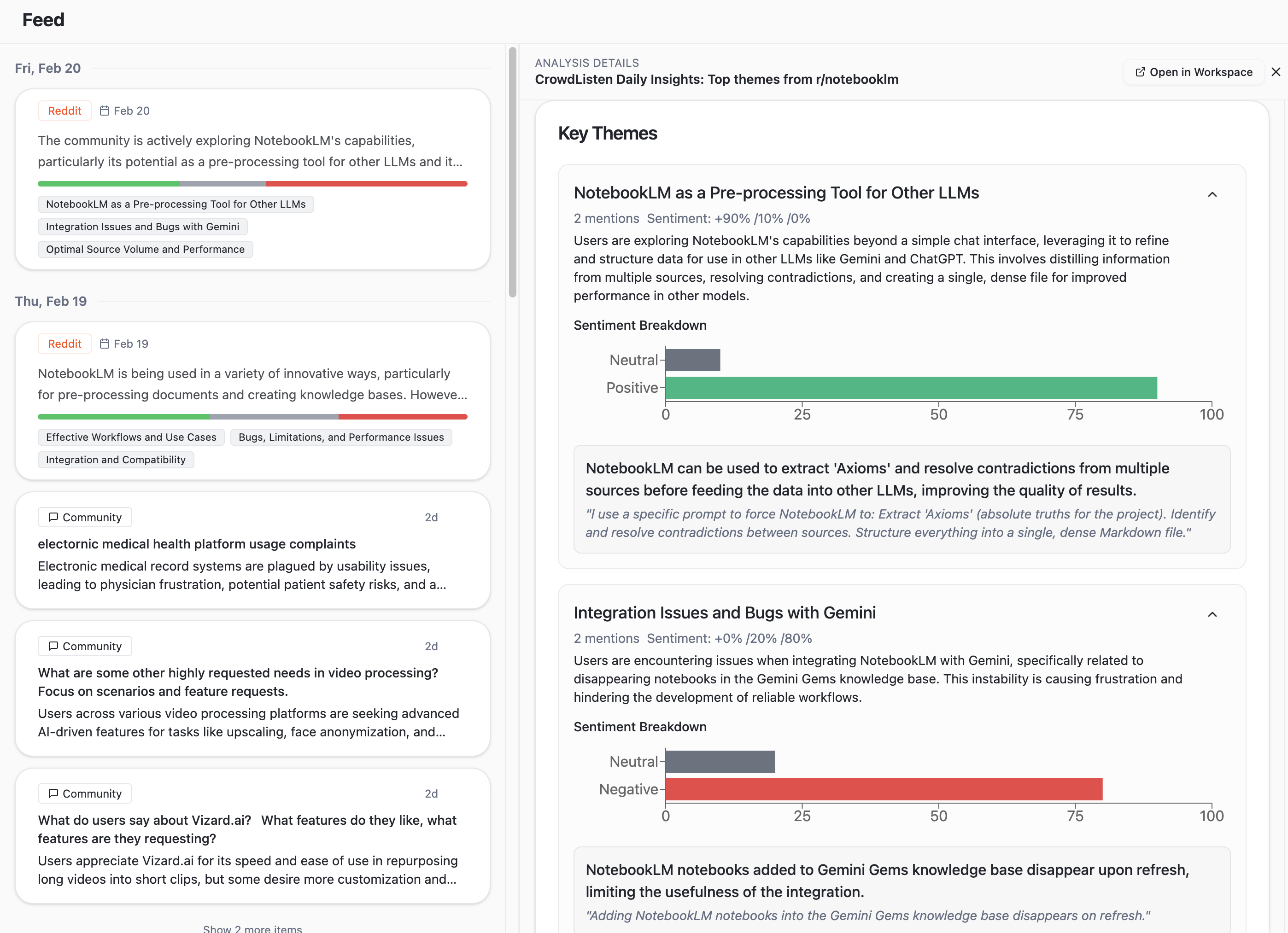 Daily insights surfaced from Reddit, TikTok, and other platforms with sentiment analysis and key themes
For prioritization, every feature request in CrowdListen’s kanban board links back to source conversations with quotes and confidence scores. No more “I think users want X.” Understanding how different segments talk about problems also helps craft messaging that resonates—you learn not just what to build, but how to talk about it.
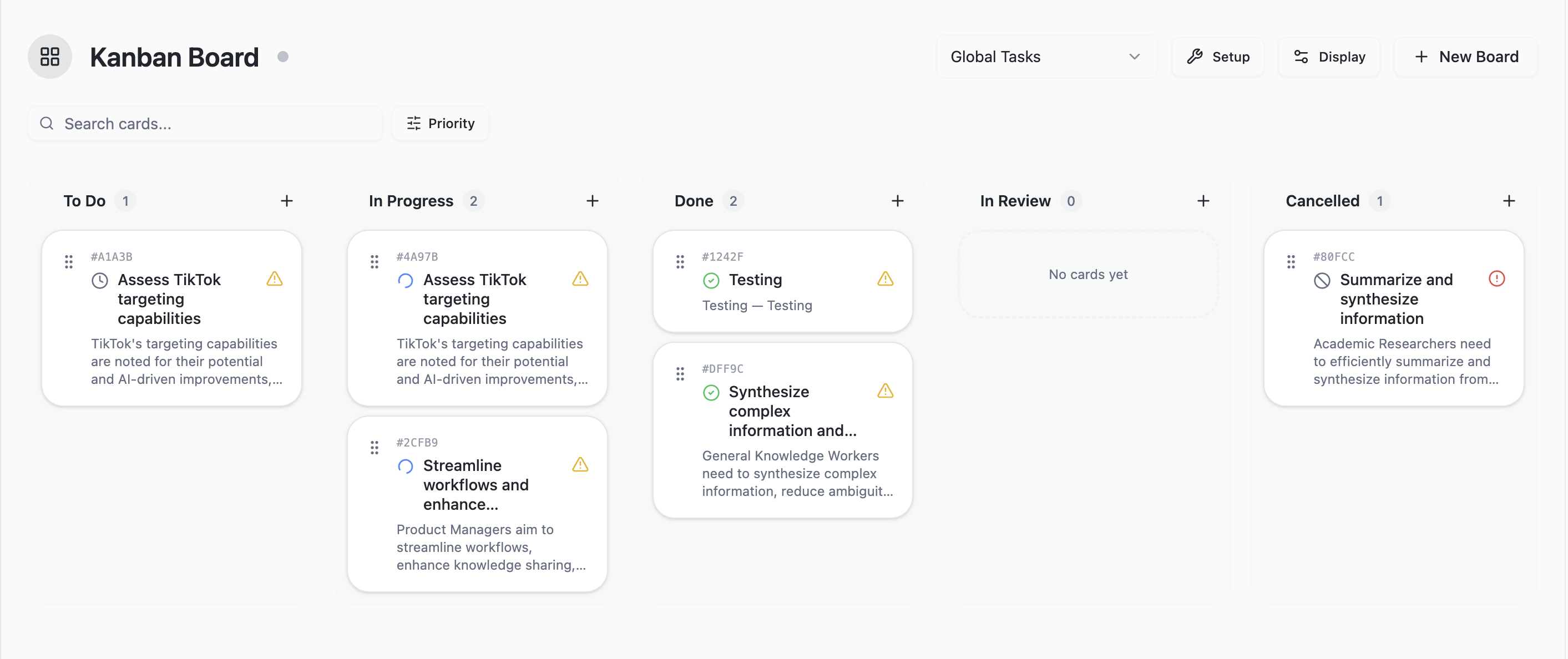 Tasks generated from user insights, ready for coding agents to pick up
This might seem like an obvious approach, but most founders skip it. There’s something seductive about the blank page, about building from pure imagination. But imagination untethered from reality produces products that solve problems nobody has. The discipline of starting with evidence, even when you think you already know the answer, consistently surfaces insights that would have taken months to discover through iteration alone.
Claude Code: Building Everything
Once you know what to build, you need to build it. Claude Code is Anthropic’s CLI tool for software engineering, and it’s become my entire engineering team.
This isn’t GitHub Copilot-style autocomplete. This is an agent that plans and executes multi-step tasks autonomously, understands entire codebases through semantic analysis, writes tests and debugs production code, manages git workflows and creates PRs, and uses MCP servers for extended capabilities like database operations and browser testing. The magic is in the iteration. Claude Code doesn’t just write code—it thinks through implications, checks for edge cases, and maintains consistency with existing patterns.
My typical workflow looks like this: I describe the feature in plain English. Claude Code explores the codebase, understands the architecture. It writes the implementation across multiple files. Runs tests, fixes issues, creates a commit. I review, approve, merge. For CrowdListen, Claude Code handles everything—React frontend, Python backend, Supabase integrations, MCP server development, deployment configurations. It’s not a coding assistant. It’s a coding agent.
What strikes me most about this shift is how it changes the nature of engineering work. The bottleneck is no longer implementation speed—it’s clarity of thought. If I can articulate precisely what I want, it gets built. If my thinking is muddled, the output reflects that. In some ways, Claude Code has made me a better product thinker because it forces me to be explicit about decisions I might have previously hand-waved through.
OpenClaw: The General-Purpose Agent
Coding is maybe 40% of running a company. The rest is operations: responding to users, writing documentation, managing tasks, coordinating between systems, handling the endless administrative work that scales with growth. This is where OpenClaw lives.
OpenClaw is a general-purpose AI agent that handles both coding and non-coding tasks. It runs locally, has full access to my filesystem, and we’ve integrated it into Slack and across split terminals so it’s always available wherever we’re working. The versatility comes from that local file access—it can read, write, and manipulate anything on my machine, which makes it useful for tasks that span multiple systems and contexts.
I use it less for coding than Claude Code, primarily because API token costs add up quickly compared to the Claude Max Plan’s flat rate. But for everything else—the repetitive operational work that would otherwise eat hours every week—OpenClaw has become indispensable. Anything that requires repetition is now almost entirely AI-handled across our team.
What does this look like in practice? Processing receipts for reimbursement. Setting up cron jobs for our newsletters. Finding and repurposing demo clips and memes for content marketing. These tasks used to be the kind of thing you’d either do yourself (tedious) or hire someone to handle (expensive and requires management overhead). Now they’re conversational requests. “Process these receipts and prepare the reimbursement spreadsheet.” “Set up a cron job to send the digest email every Monday at 9am.” “Find clips from our last demo that would work for a TikTok about feature X.” The agent interprets the request, accesses the relevant files and systems, and executes.
The mental model is simple: OpenClaw is the AI that talks to me in natural language but acts on systems. It reads SOPs, follows workflows, and executes multi-step operations without me touching a keyboard. The key difference from Claude Code isn’t that one does coding and one doesn’t—it’s that Claude Code is optimized for deep, sustained engineering work within a codebase, while OpenClaw excels at the breadth of operational tasks that keep a business running.
CrowdListen Video: Marketing at Scale
You can build the best product in the world, but if nobody knows about it, you have nothing. Marketing for a solo founder used to mean either spending hours on content creation or spending money on agencies. Neither option scales well when you’re trying to move fast.
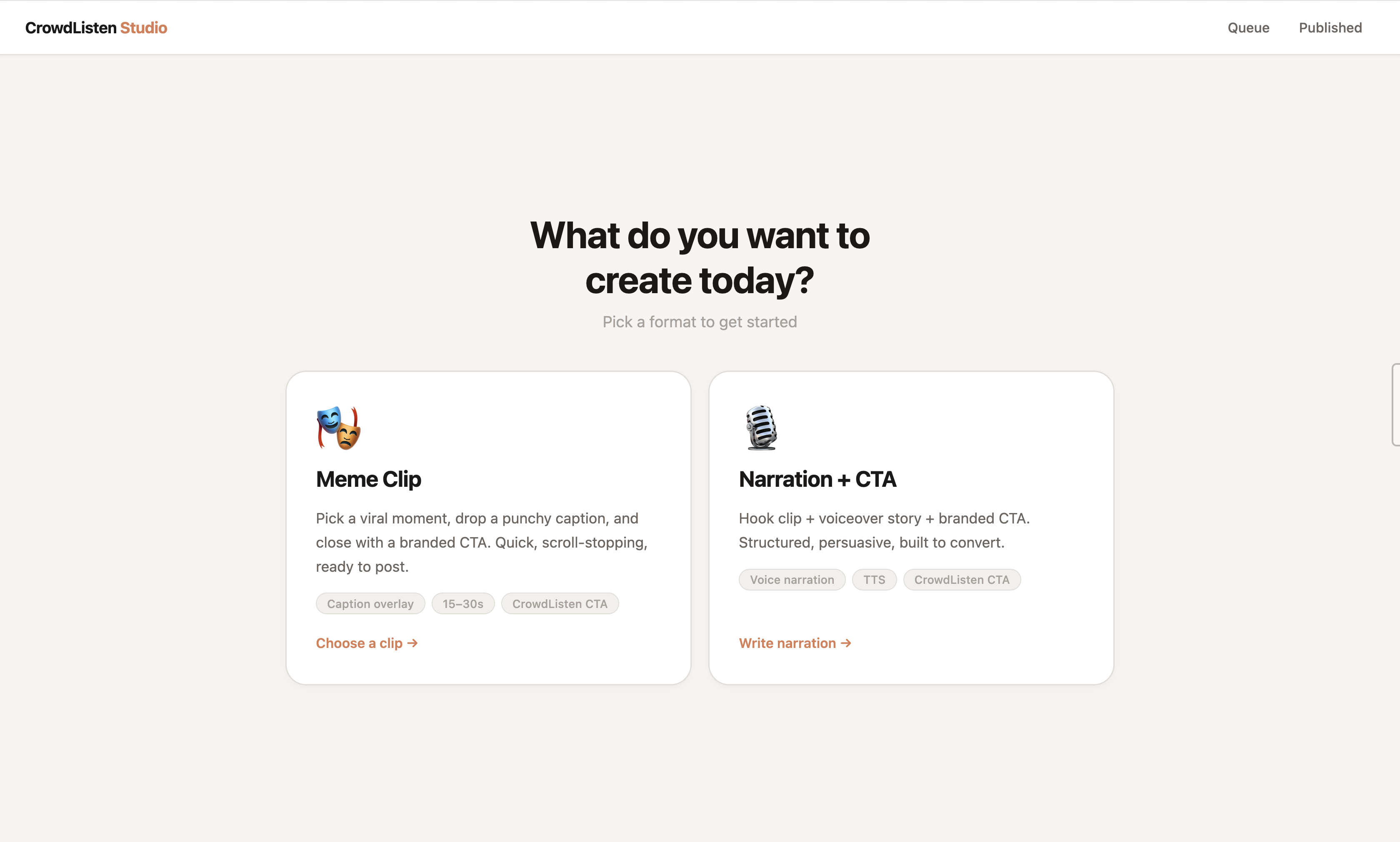 CrowdListen Studio: pick your format and create scroll-stopping content
CrowdListen Video, internally called CrowdListen Studio, is a two-interface system for creating short-form video content for TikTok and Instagram. It combines a visual Studio web app with OpenClaw’s conversational interface. The pipeline works like this: you drop a video into the system, Gemini AI watches it and returns timestamped “meme moments” ranked by energy score. This creates a clip library with 38+ pre-analyzed moments, each with scores, captions, and visual descriptions that you can browse by source or filter by score.
Content creation becomes conversational. I can tell OpenClaw “Make a clip about scope creep” and it searches the library for the best match, picks a clip with the right energy, queues the render, and notifies me when it’s done. No video editing software. No context-switching. Just describe what you want and it appears in your review queue.
What makes this approach different from hiring a content team or using a traditional video editor is the feedback loop speed. I can go from idea to published content in minutes rather than days. This matters because marketing effectiveness depends on iteration—testing different angles, seeing what resonates, doubling down on what works. When each iteration takes days, you might get a few dozen attempts per quarter. When each iteration takes minutes, you can run hundreds of experiments.
The Integration Layer
These four tools don’t operate in isolation—they form an integrated system. Market intelligence from CrowdListen tells me what to build. Implementation via Claude Code turns insights into products. Operations via OpenClaw keep everything running. Growth via CrowdListen Video brings in more users. More users generate more feedback, which feeds back into CrowdListen’s analysis. This is a flywheel, and each cycle compounds.
The philosophy underlying this stack is simple: automate everything except the parts that require your unique judgment. Vision—what should this company become? Taste—what feels right versus what the data says? Relationships—the human connections that can’t be delegated. Risk—the bets only you can make. Everything else is infrastructure. And infrastructure should run itself.
I catch myself sometimes marveling at the absurdity of it. A single person, running what amounts to a fully-staffed company, through conversations with AI systems. It sounds like science fiction. But this is just how work happens now.
What’s Next
The current stack is version 1.0. What’s coming excites me more than what already exists. CrowdListen Video will soon auto-post directly to TikTok and Instagram via their APIs. OpenClaw will manage a content calendar, scheduling and queuing automatically based on optimal timing. An analytics loop will track performance and feed back into clip selection algorithms. Most importantly, cross-system memory will allow all agents to share context about what’s been built, what’s working, and what’s not.
The one-person billion-dollar company isn’t a distant future. It’s a toolkit problem. And the toolkit is here.
Try the Stack
If you’re curious to experiment with any of these tools, here’s where to start. CrowdListen is the audience insight platform—use it to understand what to build. Claude Code is available through Anthropic. CrowdListen Video is open source if you want to build your own content pipeline.
The future of work isn’t about hiring more people. It’s about deploying the right agents.
Related Reading
- Product Engineers and AI Multipliers - How AI is transforming product engineering teams into smaller, more efficient units
- The Best Practices Lie: On Dealing with Ambiguity - Why institutional training becomes a liability in genuinely uncertain situations
- From Raw Social Data to Real Research - The technical architecture behind CrowdListen’s insight engine